1 unstable release
Uses new Rust 2024
| new 0.3.0 | May 16, 2025 |
|---|
#438 in Command line utilities
66 downloads per month
30MB
2.5K
SLoC
Contains (static library, 6MB) lib/musl/riscv64/liblzma.a, (static library, 1.5MB) lib/android/arm64-v8a/liblzma.a, (static library, 2MB) lib/android/arm64-v8a/libzip.a, (static library, 1MB) lib/android/armv7/liblzma.a, (static library, 1.5MB) lib/android/armv7/libzip.a, (static library, 1MB) lib/android/x86/liblzma.a and 31 more.
payload-dumper-rust
Android OTA payload dumper written in Rust.
What is Payload?
- Android payload is a file that contains ROM partitions like boot , system, vendor . and others. Payload Dumper extracts these partitions from the payload.bin file
features
-
Extracts all or individual images directly from payload.bin or ROM ZIP file.
-
Supports extracting individual partitions from URLs without downloading the full ROM ZIP.
-
All decompression processes run in parallel for improved performance. ( can be customised by using
--no-parallelor--threads <n>as argument )
- Output partitions Verification ✅
- Parallel Extraction ✅
- Selective Partition Extraction ✅
- Direct Extraction from URL ✅
- Incremental OTA support ❓ ( not tested )
How To Use
-
Download Binaries for your respective Platform from releases section
-
If you are using a rooted android device you might want to install it as a magisk module
-
For unrooted Android - run this in termux to install it
bash <(curl -L "https://raw.githubusercontent.com/rhythmcache/payload-dumper-rust/main/scripts/termux-install.sh")
Install via Cargo
If you have Rust and Cargo installed, you can install this tool with:
cargo install payload_dumper
Note - Installation VIA Cargo might fail if you dont have protobuf-compiler, libzip, zlib and liblzma installed on your system
Performance Metrics*
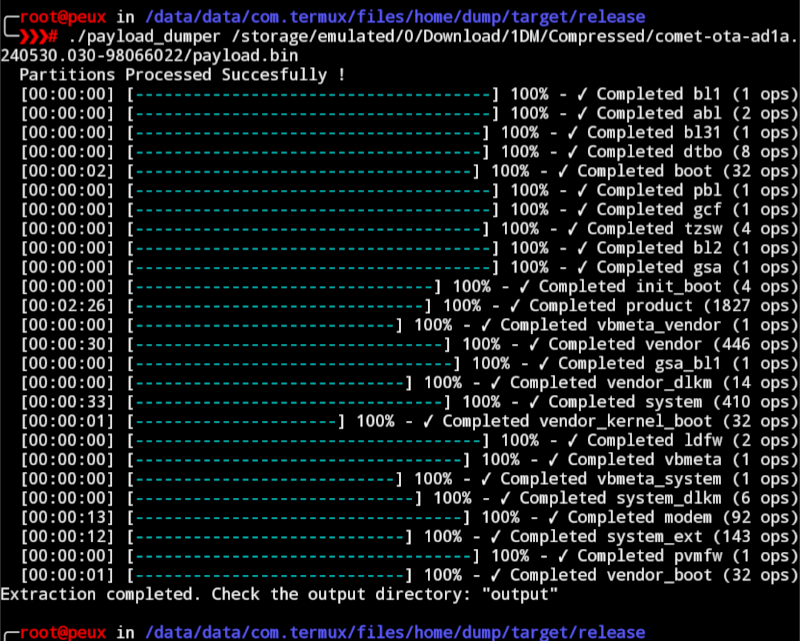
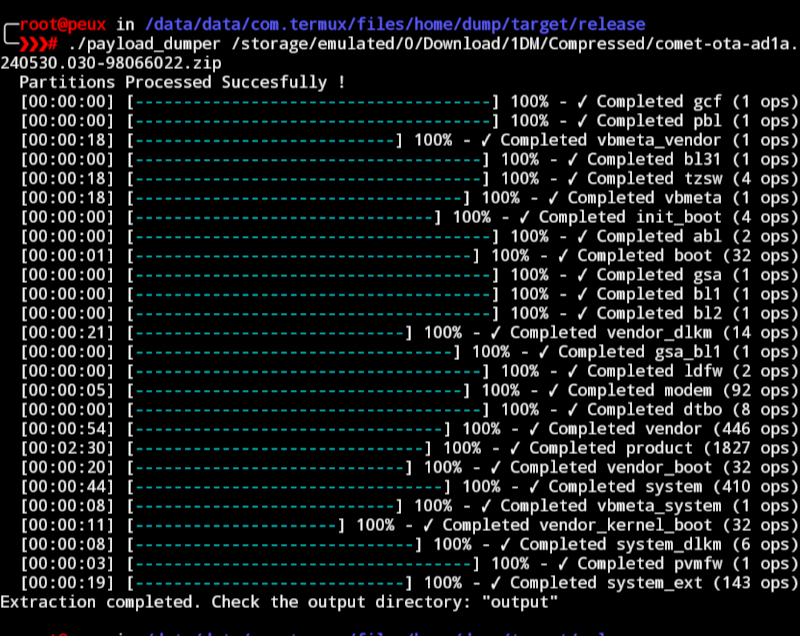
- Here are the performance metrics for Payload Dumper Rust running on a Poco X4 Pro (SD695, 8GB RAM) in Termux. The test file used is comet-ota-ad1a.240530.030-98066022.zip (2.53GB).
| Extraction Method | Time Taken | Notes |
|---|---|---|
| Direct Payload Extraction | 2 minutes 26 seconds | Extracting directly from payload.bin. |
| ZIP File Extraction | 2 minutes 30 seconds | Extracting directly from the ZIP file. |
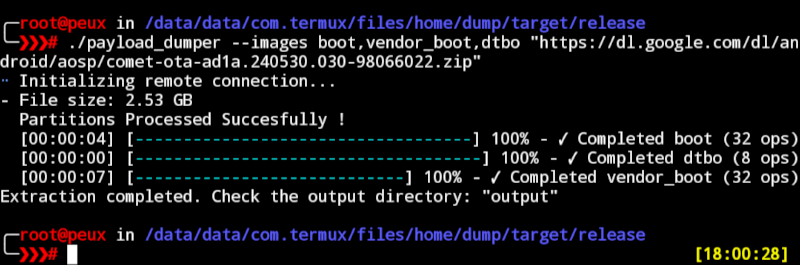
| Remote URL Extraction | Slower | Depends on network speed. |
Screenshots
-
Direct Payload Extraction:
-
ZIP File Extraction:
-
Remote URL Extraction:
Usage :
Basic Usage
To extract partitions from a payload file, run the following command:
payload_dumper <path/to/payload.bin> --out output_directory
Direct ZIP Processing
it can directly process payloads from ZIP files without requiring manual extraction. Simply provide the path to the ZIP file:
./payload_dumper <path/to/ota.zip> --out <output_directory>
Remote Payloads
it can also handle payloads/zips directly using url. Simply provide the URL as path. this is very slow compared to local extraction though.
./payload_dumper https://example.com/payload.bin
Individual partitions extraction.
- to extract individual partitions from payloads/URL/zips , use
--imagesand enter the name of partitions you want to extract comma-separated.
for example to just extract boot and vendor_boot from url/zip/payload , simply run
payload_dumper --images boot,vendor_boot <https://example.com/zip>
Usage: payload_dumper [OPTIONS] <PAYLOAD_PATH>

Arguments:
  <PAYLOAD_PATH>
      Path to the payload file.
  --out <OUT>
      Output directory for extracted partitions. [default: output]
  --diff
      Enable differential OTA mode (requires --old).
  --old <OLD>
      Path to the directory containing old partition images (required for --diff). [default: old]
  --images <IMAGES>
      Comma-separated list of partition names to extract (default: all partitions)
  --threads <THREADS>
      Number of threads to use for parallel processing.
  --list
      List available partitions
  --metadata
      Save complete metadata as json ( use -o - to write to stdout )
  --no-verify
      Skip Hash Verification
  --no-parallel
      Disable parallel Extraction
Dependencies :
Build :
To build this , you'll need:
- Rust compiler and Cargo
- protobuf-compiler
- Other obvious dependencies
- You may also need to link against libzip, zlib, and liblzma.
Credits
- This tool is inspired from vm03/payload_dumper
Dependencies
~27–61MB
~1M SLoC