6 stable releases
Uses new Rust 2024
| 1.1.9 | Mar 17, 2025 |
|---|---|
| 1.1.8 |
|
| 1.1.7 |
|
| 1.1.1 | Jan 31, 2025 |
#1601 in Network programming
123 downloads per month
155KB
2K
SLoC
Lynn_tcp




English|简体中文
Lynn_tcp is a lightweight TCP server framework
Keywords
-
Lightweight: concise code that is easier to learn and use
-
Concurrent and Performance: Based on Tokio's excellent asynchronous performance, it is easy to achieve concurrent processing capabilities for multi-user links
-
Lower latency: Design with read and write separation to achieve lower latency
-
Security: Code written with strong typing and memory safety in Rust
tips: Lynn_tcp is mainly used for message forwarding and long link TCP game servers
Quickly develop suitable business scenarios based on frameworks
Different message parsing, communication data encryption, and other operations can be achieved through custom settings
Simple Use
Dependencies
Make sure you activated the features which you need of the lynn_tcp on Cargo.toml:
full features
Use cargo add lynn_tcp or:
[dependencies]
lynn_tcp = "=1.1.9"
server feature
[dependencies]
lynn_tcp = { version = "=1.1.9" , features = "server" }
client feature
[dependencies]
lynn_tcp = { version = "=1.1.9" , features = "client" }
Server
use lynn_tcp::{lynn_server::*, lynn_tcp_dependents::*};

#[tokio::main]
async fn main() -> Result<(), Box<dyn std::error::Error>> {
    // Initialize tracing or use app.logserver()
    tracing_subscriber::fmt::init();
    let _ = LynnServer::new()
        .await
        .add_router(1, my_service)
        .add_router(2, my_service_with_buf)
        .add_router(3, my_service_with_clients)
        .start()
        .await;
    Ok(())
}

pub async fn my_service() -> HandlerResult {
    HandlerResult::new_without_send()
}
pub async fn my_service_with_buf(input_buf_vo: InputBufVO) -> HandlerResult {
    println!(
        "service read from :{}",
        input_buf_vo.get_input_addr().unwrap()
    );
    HandlerResult::new_without_send()
}
pub async fn my_service_with_clients(clients_context: ClientsContext) -> HandlerResult {
    HandlerResult::new_with_send(1, "hello lynn".into(), clients_context.get_all_clients_addrs().await)
}
Server with config
use lynn_tcp::{lynn_server::*, lynn_tcp_dependents::*};

#[tokio::main]
async fn main() -> Result<(), Box<dyn std::error::Error>> {
    // Initialize tracing or use app.logserver()
    tracing_subscriber::fmt::init();
    let _ = LynnServer::new_with_config(
        LynnServerConfigBuilder::new()
            .with_addr("0.0.0.0:9177")
            .with_server_max_connections(Some(&200))
            .with_server_max_threadpool_size(&10)
            // ...more
            .build(),
    )
    .await
    .add_router(1, my_service)
    .add_router(2, my_service_with_buf)
    .add_router(3, my_service_with_clients)
    .start()
    .await;
    Ok(())
}

pub async fn my_service() -> HandlerResult {
    HandlerResult::new_without_send()
}
pub async fn my_service_with_buf(input_buf_vo: InputBufVO) -> HandlerResult {
    println!(
        "service read from :{}",
        input_buf_vo.get_input_addr().unwrap()
    );
    HandlerResult::new_without_send()
}
pub async fn my_service_with_clients(clients_context: ClientsContext) -> HandlerResult {
    HandlerResult::new_with_send(
        1,
        "hello lynn".into(),
        clients_context.get_all_clients_addrs().await,
    )
}
Client
use lynn_tcp::{
    lynn_client::LynnClient,
    lynn_tcp_dependents::*,
};

#[tokio::main]
async fn main() -> Result<(), Box<dyn std::error::Error>> {
    // Initialize tracing or use app.logserver()
    tracing_subscriber::fmt::init();
    let client = LynnClient::new_with_addr("127.0.0.1:9177")
            .await
            .start()
            .await;
    let _ = client.send_data(HandlerResult::new_with_send_to_server(1, "hello".into())).await;
    let input_buf_vo = client.get_receive_data().await.unwrap();
    Ok(())
}
Features
server: Provide customizable TCP services that can easily achieve multi-user long connections and concurrent processing capabilities, with services for different routesclient: Provides a custom TCP client that sends and receives messages to and from a TCP server
Road maps
Basic functions
✅ Tcp server
✅ Tcp client
✅ Custom message parsing
✅ Automatically clean sockets
✅ Routing service for asynchronous tasks
Note:
All Basic functions support on v1.0.0 and above
Extended functions
- Scheduled tasks
- Middleware
- Global database handle
- Communication data encryption
- Disconnecting reconnection mechanism
Note:
If you haven't seen clear instructions, it's currently unavailable and still under development
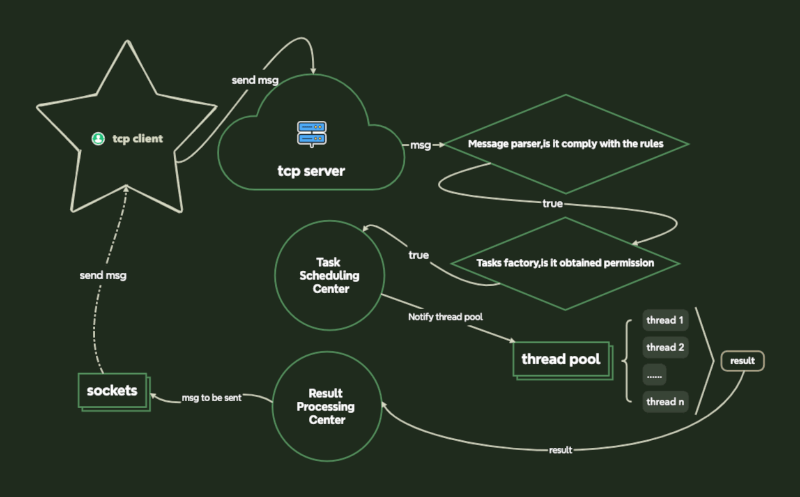
Flow chart

Release note
License
This project is licensed under the MIT license.
Contribution
Unless you explicitly state otherwise, any contribution intentionally submitted for inclusion in Lynn_tcp by you, shall be licensed as MIT, without any additional terms or conditions.
Dependencies
~5–13MB
~145K SLoC