13 unstable releases (3 breaking)
Uses new Rust 2024
| 0.4.4 | Dec 23, 2025 |
|---|---|
| 0.4.3 | Aug 31, 2025 |
| 0.4.2 | Jun 10, 2025 |
| 0.4.1 | May 27, 2025 |
| 0.1.3 | May 8, 2025 |
#66 in Visualization
63KB
1.5K
SLoC
maplibre-legend
A Rust crate to dynamically generate SVG layer legends from a MapLibre GL style JSON.
Given a MapLibre style (e.g. style.json), this library parses all layers and produces standalone SVG symbols or a combined legend, complete with optional labels and raster entries.
This project is a work in progress. It doesn't yet support all layer types, but it does cover the most common cases.
By using each layer's metadata attribute, you can flexibly customize how the legend is generated—especially the labels.
Note: Up to version 0.2.1, the behavior was synchronous. Starting with version 0.3.0, it is asynchronous. As of version 0.4.0, you can use features to explicitly define whether you need asynchronous or synchronous behavior.
Features
- Parse MapLibre GL style (v8) JSON into a structured
Stylemodel. - Render individual layer legends (fill, line, circle) as SVG snippets.
- Symbol rendering is currently limited: it is supported only when the sprites field in style.json is a string URL, and does not support sprites defined as an array of string URLs.
- Optionally include raster layers.
- Render labels and customizable dimensions (
default_width/default_height). - Stack all layers into one combined SVG with separators.
- For finer details, the metadata attribute of the layer is used.
Installation
Add this crate to your Cargo.toml:
[dependencies]
maplibre-legend = "0.4" # replace with the latest version
Features
This crate provides the following features to control HTTP request behavior:
default: This enables theasyncfeature by default.async: (Default) Enables asynchronous operations for fetching remote resources (like images or font icons). This usesreqwestwith its asynchronous configuration.- To use this feature (which is the default), just add:
maplibre-legend = "0.4"
- To use this feature (which is the default), just add:
sync: Enables a synchronous/blocking API for fetching remote resources. This is useful for scripts or environments where an asynchronous runtime isn't required. This feature is mutually exclusive withasyncin terms of API.- To use this feature, you must disable the default features and specify
sync:maplibre-legend = { version = "0.4", default-features = false, features = ["sync"] }
- To use this feature, you must disable the default features and specify
Make sure to select the appropriate feature based on your concurrency needs.
Then in your code:
use maplibre_legend::MapLibreLegend;
Usage
Asynchronous Example
use maplibre_legend::MapLibreLegend;
use tokio::fs;
#[tokio::main]
async fn main() -> Result<(), Box<dyn std::error::Error>> {
for i in 1..=3 {
let style_json = fs::read_to_string(format!("style{}.json", i)).await?;
let legend = MapLibreLegend::new(&style_json, 250, 40, true, false).await?;
let combined = legend.render_all(true)?;
fs::write(format!("combined_{}.svg", i), combined).await?;
}
let style_json = fs::read_to_string("style1.json").await?;
let legend = MapLibreLegend::new(&style_json, 250, 40, true, true).await?;
let svg = legend.render_layer("vs2023", Some(true))?;
fs::write("vs2023.svg", svg).await?;
Ok(())
}
Synchronous Example
use maplibre_legend::MapLibreLegend;
use std::fs;
fn main() -> Result<(), Box<dyn std::error::Error>> {
for i in 1..=4 {
let style_json = fs::read_to_string(format!("style{}.json", i))?;
let legend = MapLibreLegend::new(&style_json, 250, 40, true, false)?;
let combined = legend.render_all(true)?;
fs::write(format!("combined_{}.svg", i), combined)?;
}
let style_json = fs::read_to_string("style1.json")?;
let legend = MapLibreLegend::new(&style_json, 250, 40, true, true)?;
let svg = legend.render_layer("vs2023", Some(true))?;
fs::write("vs2023.svg", svg)?;
Ok(())
}
Examples
Legend Generation from MapLibre Styles
This Rust library allows you to generate legends based on a MapLibre styles.json file. It processes the style definition to extract information about layers and their visual representations, translating this into a structured legend.
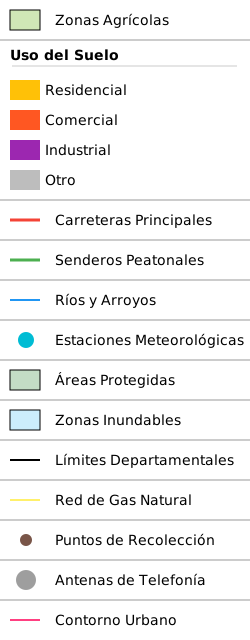
Given the included style.json (which defines various raster, fill, line and circle layers with metadata.legend.label), calling:
let svg = legend.render_all(true);
produces a full-page legend similar to:
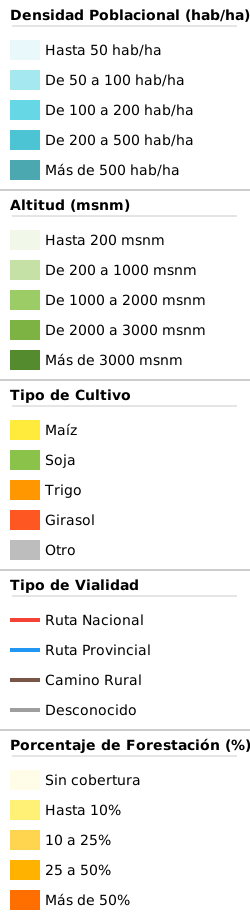
| style.json | style2.json | style3.json |
|---|---|---|

|
Customizing Legends with Metadata
MapLibre styles allow for a metadata object within each layer definition. This library leverages a specific structure within this metadata to provide fine-grained control over how the legend for that layer is generated.
The customization options are defined within a "legend" object inside the layer's metadata.
"metadata": {
"legend": {
"label": "Valor del Suelo 2016 [m2]",
"default": "Otros",
"custom-labels": [
"Hasta U$D 100",
"De U$D 100 as U$D 250",
"De U$D 250 as U$D 750",
"Mayor a U$D 750"
]
}
}
Within the "legend" object in a layer's metadata, the following keys are used for customization:
-
label
- Type: string
- Description: Sets the title for the legend entry. If omitted, the layer's id is used.
-
default
- Type: string
- Description: Provides a label for data points not covered by the style's expressions (e.g., interpolate, case, match).
-
custom-labels
- Type: array of strings
- Description: Supplies specific labels for the different categories or stops defined in expressions like interpolate, case, or match. The order should match the expression's stops/cases.
Crate Modules
circle: renders circle layersline: renders line layersfill: renders polygon (fill) layerssymbol: renders icons o T letter for symbol layersraster: renders raster layersheatmap: renders heatmap layersdefault: renders a gray polygoncommon: shared types (Style,Layer, etc.)error: thiserror structure for error handling
Contributing
- Fork the repo and create a feature branch.
- Run
cargo fmtandcargo clippyto keep code clean. - Submit a pull request—feedback is welcome!
License
This project is licensed under the MIT License. See the LICENSE file for details.
Dependencies
~8–23MB
~297K SLoC